

Safe Spaces

You can’t say you have truly lived until you have had a panic attack over a math problem.
I used to take my university midterms and finals in a room unironically named the Examination Building. All of us would cram into one of its windowless rooms, packed in like sardines as three to four teaching assistants would take turns walking the perimeter of the space, like rotating prison guards, keeping their eyes out for cheating or any other funny business.
None of my friends or schoolmates referred to the Soviet-looking concrete block structure on the corners of College and McCaul streets, which bordered the western edge of Downtown Toronto, as the “Examination Building.” Extermination or Execution Building were more suitable monikers for the former factory that the University of Toronto decided to turn into a portal to a dimension that destroys the hopes and dreams of its entire undergraduate student population.
Attending “UofT” was like living through a real-life reenactment of Darwin’s theory of “Natural Selection,” and discovering that you were evolutionarily unfit to continue in the jungle that is elite academia. I had quite a few professors who prided themselves on how many students they could fail–and I thought I was tough enough to survive each culling. Still, ultimately, I was found to be intellectually and educationally deficient in a myriad of ways.
I wasn’t emotionally or mentally prepared for exams at the Extermination building. Nor was I really mentally or emotionally prepared for Differential Equations, Quantum Mechanics, Electricity and Magnetism, Inorganic Chemistry, or Biochemical Physics, all within the same year and semester, and all before I was legally allowed to buy a beer.
I probably shouldn’t have gone away to university at all. Taking a gap year, working a full-time job, and educating myself about what the “real world” was like probably would have helped me keep my cool on that fateful proof-by-induction problem set day.
I was a gifted public school student from a poor American city whose academic hubris blinded me to the realities of attending an elite institution in an entirely different country. The University of Toronto at the time had a reputation for flunking kids on foreign exchange trips from Harvard–yes, that Harvard. Not that the name “Harvard” carries any of the same weight it used to after the dumpster fire that was the Claudine Gay antisemitism hearing (but we are talking about STEM subjects here, people). So I have no idea why I thought someone like me would be at all anywhere near prepared for getting punched in the face with science– or mugged by reality with a math problem set.
I became a full-blown academic fuck-up at the age of twenty. That’s the year I finally flunked out of university and ended up back at home and attending community college. Community college was never supposed to happen to a kid like me. I was special, I was smart, I was going places. Instead, I ended up attending classes with people whom I thought I had left in the dust.
Community college was my first real taste of failure. Community college was my first real taste of self-repair. Community college was the worst and best thing that ever happened to me, rolled into one messy year.
But before I trick all the bleeding heart liberals into thinking that I lived through the real-life plotline of “Stand and Deliver” or “Freedom Writers,” I’m just going to give you a warning now that this ain’t that kind of essay, and I ain’t that kind of writer. In addition, as I stated earlier, I did not come from some fancy preparatory academy. I am not a “Jewish American Princess,” no matter how hard my former DSA member friends (who we will return to later on in this essay) desperately want me to be, because it suits their narrative of who I am and why I think what I think.
For some outside context (because I always seem to need to add context), I sat at a lunch table in high school where two out of the five of us at that table were six plus months pregnant at prom. I also graduated from eighth grade with two girls who had children before we entered high school. I am not that kind of Jew, and this is not that kind of story–so keep your stereotypes to yourself. I am not some damsel in distress who ended up unexpectedly with the “riff raff.” I knew exactly who I was going to be attending ECC alongside, and that’s because I had already been in classes with them in middle and high school. My issue was I thought my grades meant I was “better” than them on an “intellectual” level–falling from academic grace proved I was not. And that’s the lesson I had to learn–and many more.
ECC was and probably still is a dumpster fire. Everything was falling apart–literally and physically, the professors were wack jobs, and the students were a “diverse” mixture of burn-outs, current and former drug dealers and convicts, plus the occasional “adult learner” who discovered way too late that ECC was not an institution of “higher learning” (I still feel bad for all the adult refugee students I knew) but a holding center for the socially inept and the peripherally dangerous.
But what ECC–full name is “Erie Community College” lacked in decorum, charm, and an engaging and motivated staff, it more than made up for in “grit”; i.e., great stories to tell your friends at bars because if you retold them sober, I doubt most people would think that they were true. Or at least they initially seemed ridiculous, but knowing where the state of higher education is today, I think they were more like warnings of the decline that was starting at the edges of the American Academic Industrial complex, but hadn’t yet rotted the entire log from the inside out.
I’ll start with the most batshit insane professor. His name was Dr. Robson, and he was a full-blown communist. Initially, I recall feeling bad for Dr. Robson–I almost pitied him. He was already old, with snow white hair, and wore suits that appeared two sizes too big on him to class. He was angry about how academia and the world at large had treated him and wanted us–his captive audience of History 101 students to feel his pain–as a warning for how the system eventually crushes you. Robson was an avid Howard Zinn and Noam Chomsky fan, and a connoisseur of socialist thought and 1960s baby boomer psychedelic thought experiments, which I deduced that he picked up while attending UC Berkeley in the early 1970s.
On our first day of class, he passed out a paper titled “Water Memory,” a pseudoscientific study by a Japanese businessman and part-time “researcher,” Masaru Emoto. In this “scientific study” which had nothing to do with history (by the way) Emoto placed certain sticky notes on glasses of water with words like “Happiness,” “Kindness,” “Cruelty,” etc, and “analyzed” how their water crystals differed based on the “energy” the flavor of speech gave off–or in gen Z speak “the vibes.” Anyone can see that this “study” was bullshit, and yes, I think the mouthful of quotation marks is necessary for a paper that was never peer-reviewed based on qualitative observations on the shapes of ice crystals solely predicated on the perceived positive or negative perceptions of arbitrarily pinned words on glasses of water.
I learned nothing new in Robson’s class and got an A, echoing back his own crazed beliefs on exam essays; a technique that I would learn to apply to all my English and Humanities classes for the rest of my college degree. Would it surprise any of you to know he was also a DSA member and was really into supporting any cause that had “socialist” in the name? Robson liked me, so part of me feels bad for bashing him now. I also know that he was fond of me because I was an elite school dropout, which made me “not like the others.” He would sometimes take me aside and tell me not to tell anyone where I went to school before landing at ECC, warning me that saying I had gone to a top university would hurt me down the road.
This “quality” of education was the norm at ECC. My history of World War Two class, which I took the semester afterwards, rivaled Dr. Robson’s ahistorical screeds and assignments. All I recall about the instructor was that she was a middle-aged white lady who loved using television programs from the History Channel to “teach” us about the Nazis.
As someone who was raised by older Jews with thick accents from a variety of European countries, I obviously had some opinions about the War; however, even I was taken aback by how ideologically slanted the class was. And no–I am not advocating for any sympathetic portrayals of the Nazis; however, I was also raised in part by a “step-grandparent” of sorts who was forced to build fighter jets for the Third Reich (my German-Jewish grandpa had a German girlfriend later in life). While this may feel like a tangent–it’s not, it’s to indicate that I had a nuanced understanding of the war and the suffering that occurred based on (cringe) “lived-experience” that was ironically not welcome in a supposed “college-level” course on the subject.
Instead, we were forced to watch terribly narrated videos about Hitler’s “putrid paintings” where the Nazis were portrayed as cartoon villains straight out of Rocky and Bullwinkle rather than actual human beings indoctrinated into ideologies they didn’t fully understand. We were not taught about how or why this happened or how to build the situational awareness to recognize this political behavior in modern times.
What we did do was compare the Nazis to the Republican Party. And also completely ignore other fascist regimes altogether, including what occurred in Italy with Mussolini, Franco in Spain, the Ottoman Empire, and imperial Japan. There was limited discussion about Stalin’s pact with Hitler at the beginning of the war, or the role Marxism initially played in stirring up antisemitic feelings throughout Europe. If we had focused on any of this–including the role of communism in creating authoritarian states, there may have been too many difficult conversations about Mussolini’s sympathy towards socialism and the confusion that followed his “supposed” ideological shift from one ideology to the other, and why the shift to “fascism” was so seamless for a person who advocated for state control of corporations. Or, in addition, why Hitler targeted communists for indoctrination into fascist ideologies. While again this may seem like a tangent–it’s not. The academy in Germany, one of the most intellectually advanced systems in the world at the time, contained a large number of Nazis–it’s worth asking ourselves why.
No, community college wasn’t real college at all, it was a degree mill to push people through a system where half the student body needed to take remedial math–because they had never grasped how to add or subtract fractions (I’m not kidding). How can you teach history to a student body that cannot read or add? But funnily enough, what I was seeing at ECC was actually being amplified at the highest levels of academia as well–I was just too embarrassed by my “failure” to see it.
Up until I was forced to take humanities classes with the normies, I was sheltered from the impacts of the intellectual decline occurring within social science and liberal arts curricula in higher education. My crazy course load of science classes shielded me from being exposed to the way history and literature were being wielded as weapons by a professoriate class bent on forcing students to imbibe their very specific worldview. While this was easier to do to a population already stuck taking remedial math and english classes where reading comprehension hovered around a 3rd-4th grade level like ECC, elite students were also not immune to this grift. In fact much of this stuff was started at stuffy schools like Harvard, and then trickling down to less esteemed institutions like the state schools and community colleges where us plebeians were subjected to third rate educations at fourth rate schools.
Dr. Robson felt that he was above educating the riff raff because he had happened to graduate with a doctorate from a school with “name brand” recognition, even though the ideas he was peddling were littered with conspiracy theories, personal grievances, and political grift. Robson also did not tolerate dissent or provide materials pushing back on his more batshit crazy claims or ideas. Similarly, my History of World War 2 class didn’t provide any first-hand accounts of German, Italian, or Japanese civilians or soldiers during the war, neglecting an important facet of teaching war history–learning the perspective of the opponent and enemy in addition to one’s own side.
When I finally moved on to my mediocre state school and started taking art history classes, I noticed this pattern continue, where a professor’s perspective on an event or time period was used as the “end all and be all” of one’s education on the subject. Students in those classes were expected to swallow the narrative hook, line, and sinker without being able to ask pertinent questions or poke holes in the arguments provided by the instructor.
My modern art history class, for instance, focused an exorbitant amount of time analyzing the coke-fueled writings of Wassily Kandinsky and being “tested” on his black versus white hand rambling as something profound and worth heavy analysis, while waving away the entire period of impressionist art as ephemeral, superficial, and “silly.” This undue weight and value to one period and person over another was due entirely to my instructor’s apathy towards French and European art of the late 19th and early 20th century, and near obsession with post-modern and abstract expressionism based on her own opinions and theories.
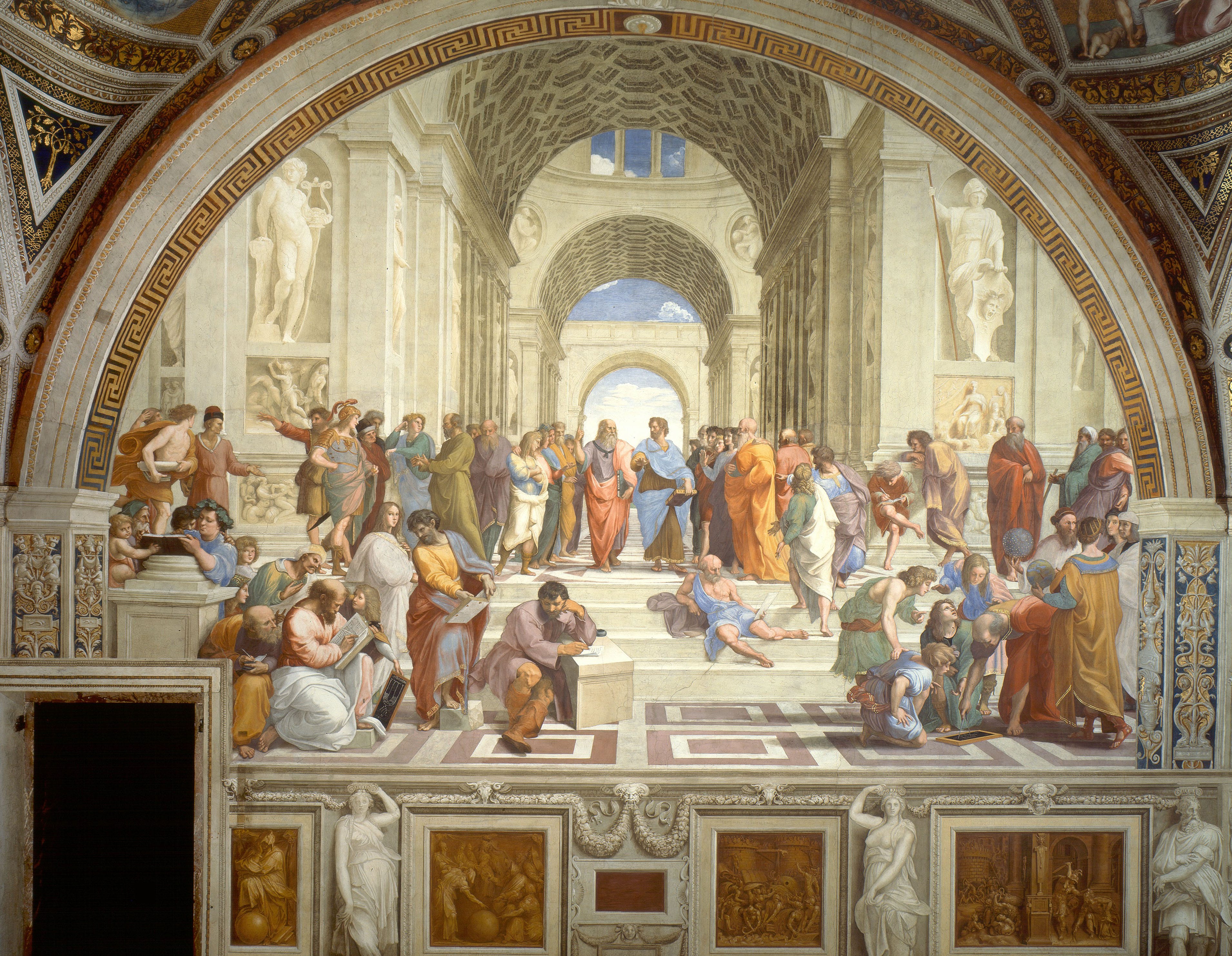
My Hungarian art-history instructor (I have forgotten her name) also spent an inordinate amount of the class comparing post-impressionist artist Paul Cezanne’s “Basket of Apples” to the Renaissance artist Raphael’s “School of Athens.” She spent weeks pontificating that these two paintings were essentially the same, and I would just like to add that this class was twice a week and an hour long. Of course, this culminated with an exam where we were forced to write an essay comparing and contrasting the two (dare I say) WILDLY different pieces of art–not that my essay dared dissent from my instructor’s dogmatic point of view.
It was during this time of my life, post-University of Toronto, that I fell in with my former and decade-plus-long friend group of progressive-socialist and now full-blown communist friends. All of them became members of the Democratic Socialists of America, or DSA for short. Many of them I met in art classes and on art walks–I no longer think this was a coincidence.
My friends who would eventually become DSA members were very proud of their social and humanities degrees. Two of them were school of architecture drop-outs from the University at Buffalo who went into the humanities instead, getting degrees in Sociology, Psychology, and American Studies. Almost all of their assigned reading was rooted in “decolonial theory,” where they were fed a steady diet of Edward Said, Franz Fanon, and post-structuralist writing by Judith Butler, Foucault, and Sartre.
When I pushed back on narratives being sold to them regarding Cuba, Iran, Venezuela, (the one benefit I had was that I was an avid reader of literature regarding the cultural revolution and the 1979 Iranian Revolution at a very young age) their retort was normally books written by left-wing westernized intellectuals who were sympathetic to these regimes, pushed on them by professors educated at schools several tiers above the institutions where we were being force-fed the academic equivalent of slop. Did any of these classes make their student populations read books by regime dissidents to balance books extolling the benefits and superiority of communism over capitalism, like a Solzhenitsyn or any firsthand accounts of the Cambodian Genocide to counter Noam Chomsky’s celebration of the Khmer Rouge? If they did, their narratives clearly weren’t compelling enough to dissuade many of my peers from becoming tier 3 state school socialists.
But my elite schoolmates were also not immune to this indoctrination–I just noticed it much later on. While I was no longer attending UofT, I was still friends with many of my old classmates on social media, so I could see what they were posting and what political discourse they were having.
My last year in Toronto, before my crash out, pro-Tibet demonstrations gripped the campus and spilled out into the larger city space. Tibetan monks were self-immolating in protest of China’s suppression of Tibetan culture. These protests coincided with the 2008 Beijing Olympics, which brought renewed attention and scrutiny to China’s human rights record and abuses. At the time that I attended the University of Toronto, the student body was over seventy percent asian, with Chinese students making up a significant proportion of this ratio. I recall the visceral anger among my Chinese-Canadian and Chinese national friends and classmates. Posts were made all over social media extolling Han-Chinese development projects in Tibet and the apparent “ethnic diversity” of the country, with some students claiming that “China was more diverse than the United States of America.”
While this rhetoric swiftly died down after the summer games ended, the sympathy for authoritarian regimes and leaders did not. One of my closest friends at the time, a Chinese-Canadian girl named Jenny, who was a dual major in Biology and History, developed a disturbing fascination with Stalin.
Forced to study Biology, she studied History as a way to spite her strict Chinese-Canadian immigrant parents. We would have hours-long conversations over Facebook Messenger where Jenny would extoll the virtues of Stalin and the USSR–Jenny was enamored by Stalin, comparing him to the likes of Barack Obama. Her thoughts, feelings, and ideas on the authoritarian leader appeared to be entirely driven by a select history professor’s interpretation of the history of the Soviet Union.
I fell out of contact with Jenny well over a decade ago, but part of me wishes I could ask her more questions about what she learned in this history class with my fully formed adult brain and greater depth of knowledge of the USSR. Was she taught about the gulags? The Holodomor? Who taught this class? And where did they come from? How did they end up teaching history at one of the most elite institutions in the world? I will never know.
After I left UofT, I watched from a distance as one of the smartest girls I had ever met, a dual immunology-English major named Belle, became politically radicalized in real time. Admittedly, I was also swimming in the soup of left-wing ideology, so I can only see what was happening now that my worldview has broadened with age and distance. I can still remember Belle’s Facebook posts, which oddly all centered around the American left-right political binary, even though Belle was also (like Jenny) Chinese-Canadian.
I can distinctly still recall one post that she shared, which arguably could be considered the ancestor to today’s “mis” or “dis” information involving an arguably fictitious supermarket incident where a Navajo woman was chastized by a presumably ignorant red-neck American for speaking her “native tongue” in the checkout aisle, which the “dumb white American” mistook for “Mexican.” Posts like this, which Belle (and me as well–I am guilty too) shared with reckless abandon, were used to showcase our liberal values and, in addition, to separate us from the “uneducated” normies who didn’t know the difference between Mexican the ethnicity and Spanish the language. I recall some of my friends who still attended school with Belle expressing annoyance with her political views–but at the time, considering Belle and I were more ideologically aligned than opposed, I couldn’t understand what “views” they took issue with, because Belle’s positions and mine were almost entirely indistinguishable.
However, I can now zoom out and see how Belle’s posts veered into the territory of what we may now call a “social justice warrior.” And her political stances also had real-world consequences for people she loved. Once Belle went off to medical school, her parents were stuck saddling all of her medical school expenses. And because Belle was so stubborn about not applying for financial scholarships because she sincerely believed she was too “privileged” to deserve them, her parents were almost driven to financial ruin by the exorbitant costs.
Most of us who were friends with Belle agreed she was not indoctrinated by her biology or chemistry course load. But one must wonder what she was taught in her English literature classes. Belle was the child of Chinese immigrants who left Canada because of the draconian government overreach of the Chinese Communist Party–so I am skeptical that she got any of her more far-fetched left-wing ideas from them. But just like Jenny, I can’t go back and ask Belle what books she was assigned to read in class and what possible “radical” political interpretations she was expected to regurgitate to excel academically.
The counter-narrative to all of this was my former friend Anhthu, who no longer goes by the name Anhthu (it’s Anna now, and she is a bigwig Amazon executive). Anhthu was one of the five classmates I shared a lunch table with in my last year of high school, and one of the three out of the five of us who were not pregnant at prom. Anhthu was Vietnamese, which is an important distinction from my upper-middle-class Chinese-Canadian college friends.
Anhthu’s father had spent seven years in a Veitcong re-education camp, and she was one of dozens of kids of Viet, Lao, and Khmer descent that I attended my formative elementary to high school years with. I would also see many of this population again when I dropped out of fancy school and found myself back where I started–at ECC.
Anhthu had come to the United States as a refugee at the age of ten and, like many of my classmates, had lived part of her early childhood in a camp on the Thailand-Vietnam border. She hated communism to the point where she refused to wear certain styles of jackets that reminded her too much of the military garments worn by the Vietcong. Her family, like other southeast asian refugee families I went to school with, all of them lower to working class economically, voted Republican. At the time, this discrepancy broke my brain. Because I was taught and imbued with the notion that only rich white people and those of limited intellect leaned Republican. “Oppressed” groups like Anhthu, who was also the valedictorian of our school, weren’t supposed to favor John McCain over Barack Obama.
I can still recall her visceral reaction to the material I was being taught in Dr. Robson’s history class. The way she flinched, the way she talked about communist re-education camps, but I didn’t understand. To me, in all my years in schooling, I was just given one side of history by instructors who also thought that their pedigree made them immune to propaganda, but in reality, had sheltered them from opposing views and schools of thought.
Class was a factor in all of this, and so was elite capture. Dr. Robson blamed his failure to ascend to a higher institution on “the system.” He never questioned his teaching methods or intellectual abilities, because his Berkeley degree was his proof of pedigree. Along the way, I ran into many more instructors whose elite backgrounds made them angry and bitter about the level of student and quality of academic institution they became “trapped” teaching in.
But students are also not innocent bystanders in their own educational attainment, either. I feel lucky that I had enough curiosity and wherewithal to read books beyond the historical instruction I was given in school, because reading and having friends like Anhthu is what ultimately saved me from being completely ideologically captured. But many students aren’t built like me–and I am worried this problem is getting worse at the elite and mediocre levels.
Harvard now has a remedial math class and diversity of skin color is still valued more than diversity of thought and experience. The replication crisis is now rippling through the scientific community, where peer-reviewed published experiments can not be repeated with the same results in a different lab. And before the Supreme Court testimony fiasco, where three college presidents were unable and unwilling to answer if calling for the genocide of Jewish students constituted calls for incitement to violence, the biggest academic scandal surrounded Stanford’s president, when an undergraduate student journalist had broken the news that the president of one of the most elite institutions in the world had fabricated scientific data in his lab-for years.
One of the reasons I initially felt superior to my peers in terrible state schools is because I thought studying science at a top institution made me immune to imbibing propaganda. I thought having a hard sciences degree was worth more than a humanities degree because the truth was harder to misconstrue and twist. But with the introduction of post-modern thought like gender-ideology into areas like Biology this is also no longer the case. As dogma outpaces intellectual honesty, the only distinction I can see between our fancy elite institutions and our lower-tier public schools is the name recognition and the price tag.
I looked down at Anhthu for pursuing a business degree. It was too practical, too hollow, but the girl from a refugee camp is now making over 200,000 a year at one of the biggest corporations in the entire world–and she did that all without attending a fancy school. Meanwhile, I have former friends from much cushier social classes than Anhthu, whose academic degrees and current economic grievances have pushed them into the arms of radical political parties with violent genocidal fantasies of governmental collapse and class revolution.
I don’t think it’s a coincidence that some of the largest and most violent college protests took place on elite college campuses–where history was distorted to fit a narrative. Instead of these students exhibiting a genuine curiosity about the Middle East and the history of the region, they seem to be much more comfortable regurgitating a choice set of talking points–the same set of slogans chanted by my friends who appear to have been led astray by professors whose elite pedigrees also made them cock-sure of their worldviews, instead of questioning them.
When the latest attempted assassination on President Trump happened, I was watching a Hasan Piker livestream on Twitch. Piker–whom I have written about twice prior is having a “moment.” However, all of the recent writing and screeds about him don’t (in my opinion) get to the heart of the issue with his content. Piker touts his “Political Science’ degree that he received in 2013 as an assertion of his intellectual authority over his “hot takes” and opinions. An expensive piece of paper Piker received over a decade ago from Rutgers University, after flunking out of the University of Miami with a 1.9 GPA, is his “seal of approval” with the DSA and the left-wing masses. The Nation Magazine says critics are scared of Piker. The New York Times has given Piker five separate op-eds and write-ups in the past year. I got to see Piker squeal on screen in real time while he called Kash Patel “a cuck.”
But Piker isn’t especially that bright–he is clever and probably a tool of the CCP, which gave him an all-expenses-paid trip several months ago, in addition to the IRGC, which occasionally plays Piker’s livestreams on Iranian State TV. What disturbed me more was the would-be assassin Cole Allen Thomas, whom Piker called “a nerd.” Because I knew Cole Allen Thomases–they went to school with me. Thomas was brilliant. A graduate of Cal Tech who got a degree in mechanical engineering, who also enjoyed making video games about particle physics (I admit his game Bohrdom piqued my interest).
In the last week, Hasan Piker has gone on what I can only call a “crash-out” trying to distance himself from the latest domestic terrorist attack. Piker has dug up tweets and posts from Thomas, which “prove” that Thomas was not radicalized by “him.” I find this absurd–mostly because Thomas is clearly several if not multiple IQ points above Piker–Hasan, while definitely a terrorist supporter, can rest easy–I don’t think Thomas was watching his stupid livestreams. But the question remains–how was Thomas radicalized, how does someone that intelligent convince themselves that they are our country’s only hope in the face of an evil “cabal” of pedophiles? All I know is I know some very smart people educated in the best universities in the world who also seem to believe similar things.
I ended up getting a Fine Arts degree and a Chemistry degree with an Art History minor. It’s not what I initially wanted, but I don’t think I was deprived of knowledge anymore because I didn’t get it at the “right” school. However, I am worried about the future, and I am still worried about many of my peers who took their schooling as the end all and be all on learning and intellectual thought. Professors are supposed to be temporary authority figures–not what you base your entire belief system on, and as we can see with the plethora of recent academic scandals, an institutional overhaul is probably long overdue.
I used to think flunking out of UofT was the worst thing that had ever happened to me. For years, I carried it around like a moral failure, proof that I simply wasn’t smart enough to survive elite academia. I thought community college was where ambition went to die. I thought transferring to a mediocre state school meant I had permanently fallen off the track reserved for people who were supposed to become Important.
But age has complicated that shame.
Because the older I get, the less convinced I am that prestige and wisdom are the same thing.
Some of the smartest people I have ever met outsourced enormous parts of their worldview to professors, institutions, and ideological trends they mistook for intelligence itself. Many of us, myself included, confuse educational pedigree with intellectual independence. We thought being “educated” meant we were immune to propaganda, emotionally manipulative narratives, or groupthink. In reality, higher education often just made us more sophisticated in the way we rationalized what we already wanted to believe.
Flunking out interrupted that process for me.
It forced me into classrooms filled with people I had spent my entire adolescence believing I was better than. Refugees. Adult learners. Burnouts. Single mothers. Former addicts. Veterans. People whose lives had exposed them to political realities that no textbook or seminar discussion could fully replicate. For the first time in my life, I was surrounded by people who did not treat institutional authority as sacred, because institutions had already failed them long before they failed me.
That experience gave me something my elite education did not: intellectual distrust.
I still carry shame about flunking out. I probably always will. But when I look at the current state of higher education — the scandals, the ideological rigidity, the collapse of public trust, the inability of supposedly brilliant institutions to distinguish scholarship from activism — I no longer see my departure from elite academia as purely a failure.
I think, strangely, it may have saved me.